
Chapter 7: Cardiopulmonary Resuscitation (CPR)
Nazrin Ahmad
Learning Objectives
Type your learning objectives here.
- Describe what cardiopulmonary resuscitation is (CPR).
- Demonstrate the correct use of an AED.
- Explain when to stop CPR.
- Perform high-quality CPR for adults, children, and pregnant women.
7.1 Introduction to Cardiopulmonary Resuscitation (CPR)
CPR is the essential life-saving intervention for individuals experiencing sudden cardiac arrest (SCA) who have no pulse and are either not breathing or only gasping. It is a manual technique that temporarily takes over the function of the heart and lungs, ensuring vital organs receive sufficient oxygen to sustain life. Without a proper oxygen supply, irreversible damage, particularly to the brain, can occur within five minutes. CPR involves chest compressions, rescue breathing, and the use of an automated external defibrillator (AED). For non-medical personnel, hands-only CPR, focusing on correct chest compression technique and maintaining high-quality compressions, is strongly recommended. Challenges often arise when rescuers hesitate due to a lack of knowledge or skills, or from concerns about infectious disease transmission, which relates to the ‘Danger’ step in the DRSABC approach.
7.2 Chain of Survival
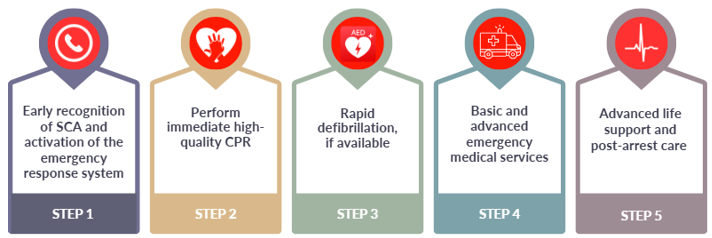
The chain of survival refers to a sequence of critical actions that, when performed effectively, can improve both survival rates and neurological outcomes following cardiac arrest. It is composed of six interdependent links: early recognition of cardiac arrest with immediate activation of emergency medical services, prompt initiation of CPR, rapid defibrillation, timely advanced cardiac life support, and comprehensive physical and emotional recovery. The initial three links are actions that can be undertaken by laypersons at the scene. In contrast, the latter three require intervention from trained healthcare professionals. Although 70–90% of cardiac arrest patients still die before reaching the hospital, survival remains possible when bystanders respond swiftly and appropriately.
7.3 High-quality CPR
The effectiveness of CPR not only depends on the skill of chest compression, but it is also highly influenced by the quality of CPR being performed. The key components of high-quality CPR that each rescuer must perform are as follows:
- The chest compression rate is 100-120 per minute (follow the metronome beat)
- Allow complete chest recoil
- Minimise interruption. If permitted, it should not exceed 10 seconds.
- Avoid excessive ventilation (rapid delivery of rescue breath)
- The compression depth is at least 50mm (2 inches) for adults and 1/3 of the anteroposterior diameter of the chest for infants and children.
- Perform five cycles of CPR before re-checking the carotid pulse. For adults, each cycle consists of 30 chest compressions followed by 2 rescue breaths. For infants, the ratio is 30:2 when performed by a single rescuer, and 15:2 when performed by two rescuers.
- Do chest compressions at the centre of the chest for both adults and infants.
7.4 Adult CPR (normal condition)
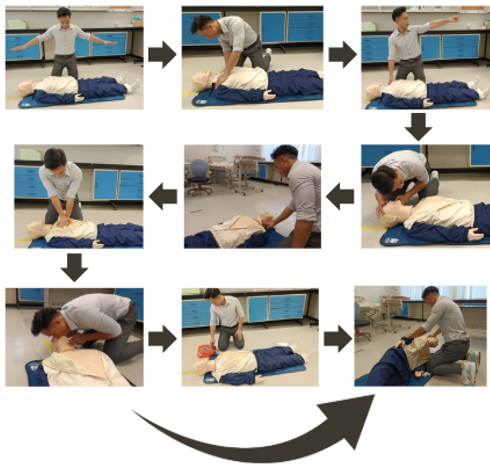
- Check for Danger: Ensure the area is safe and look for any potential hazards, such as environmental risks or exposure to body fluids. If available, wear protective equipment like a surgical mask, disposable gloves, or a face shield.
- Assess for Responsiveness: Gently tap the victim’s shoulder and ask loudly, “Hello, sir, are you okay?”
- Call for Help: If there is no response, shout for assistance. Point to a specific person and instruct them to call 999 (or the local emergency number) and bring an AED.
- Airway: Inspect the mouth for any obstructions, foreign objects, or abnormalities that may block the airway. You may use the head-tilt-chin lift or jaw thrust to open the airway if required.
- Breathing: Check for normal breathing by observing chest movement.
- Circulation: Palpate the carotid artery (neck pulse) for no more than 10 seconds. If there is no detectable pulse, start high-quality CPR immediately.
- CPR Cycles: Perform five cycles of CPR (30 chest compressions followed by 2 rescue breaths per cycle) before reassessing the carotid pulse within 10 seconds. If no pulse and the patient is spontaneous, continue to perform high-quality CPR.
- If an AED is present, attach the pads and follow the instructions. If not, continue standard CPR.
- Recovery Position: If a pulse is present after five cycles, place the victim in the recovery position, lying on their side with their face turned toward the rescuer.
*You may assess ‘airway’ and ‘breathing’ simultaneously by the look, listen, and feel technique.
7.5 Pregnant Women’s CPR
- Check for Danger: Ensure the area is safe and look for any potential hazards, such as environmental risks or exposure to body fluids. If available, wear protective equipment like a surgical mask, disposable gloves, or a face shield.
- Assess for Responsiveness: Gently tap the victim’s shoulder and ask loudly, “Hello, sir, are you okay?”
- Call for Help: If there is no response, shout for assistance. Point to a specific person and instruct them to call 999 (or the local emergency number) and bring an AED.
- Airway: Inspect the mouth for any obstructions, foreign objects, or abnormalities that may block the airway. You may use the head-tilt-chin lift or jaw thrust to open the airway if required.
- Breathing: Check for normal breathing by observing chest movement.
- Circulation: Palpate the carotid artery (neck pulse) for no more than 10 seconds. If there is no detectable pulse, start high-quality CPR immediately.
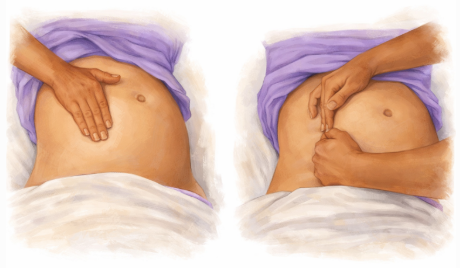
- After 20 weeks: tilt the mother 15–30° left or move the uterus left to prevent vessel compression and improve blood flow.
- CPR Cycles: Perform five cycles of CPR (30 chest compressions followed by 2 rescue breaths per cycle) before reassessing the carotid pulse within 10 seconds. If no pulse and the patient is spontaneous, continue to perform high-quality CPR.
- If an AED is present, attach the pads and follow the instructions. If not, continue standard CPR.
- Recovery Position: If a pulse is present after five cycles, place the victim in the recovery position, lying on their side with their face turned toward the rescuer.
*You may assess ‘airway’ and ‘breathing’ simultaneously by the look, listen, and feel technique.
7.6 Infant CPR
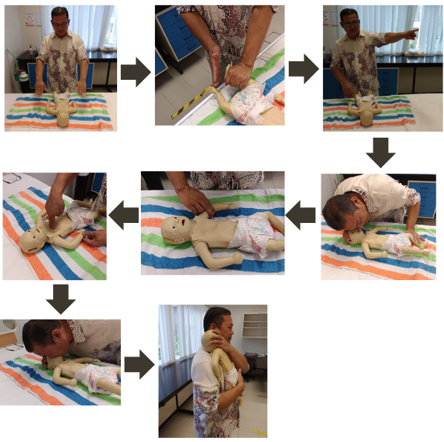
- Check for Safety: Make sure the environment is safe. Watch for hazards such as unsafe surroundings or exposure to bodily fluids. Use protective equipment if available (such as a mask, gloves, and a face shield).
- Check for Responsiveness: Gently tap the infant’s foot or flick the sole, and call out to see if there is any reaction.
- Call for Help: If there is no response, shout for assistance. Assign someone specifically to dial 999 (or local emergency number) and to bring an AED.
- Airway: Look into the mouth for any obstruction or foreign object. Open the airway gently using the head-tilt, chin-lift method (be careful not to overextend the neck).
- Breathing: Assess breathing using the ‘look, listen, and feel’ technique—watch the chest, listen for breath sounds, and feel for air movement.
- Circulation: Check the brachial pulse (inside of the upper arm) for no more than 10 seconds. If no pulse is detected, begin CPR immediately.
- CPR Cycles:
Single rescuer: Perform 30 chest compressions followed by 2 rescue breaths. Use two fingers for compressions, pressing about 4 cm (1.5 inches) deep.
Two rescuers: Use the two-thumb encircling technique and perform 15 compressions followed by 2 rescue breaths.
Complete five cycles of CPR before reassessing the pulse. If still absent, continue high-quality CPR. - AED Use: If a pediatrician’s AED with pediatric pads is available, attach them and follow the device’s prompts. If not, continue CPR without delay.
- Recovery Position: If a pulse is present after five cycles and the infant is breathing, place them in the recovery position (on their side, facing the rescuer).
7.7 When to stop CPR?
The rescuer may stop the CPR if one of the following is present:
- The victim regains return of spontaneous circulation (ROSC).
- The rescuer becomes too fatigued to continue.
- The emergency response team arrives and takes over the situation.
- Another trained person is available to relieve the initial rescuer.
- There are irreversible signs of death, such as decapitation (the head separated from the body).
- The victim’s family requests discontinuation of CPR.