
Chapter 6: Automated External Defibrillator (AED)
Nazrin Ahmad and Sharinah Abd Kassim
Learning Objectives
Type your learning objectives here.
- Explain what is an Automated External Defibrillator (AED).
- Demonstrate the correct operation of an Automated External Defibrillator (AED).
6.1 Automated External Defibrillator (AED)
An Automated External Defibrillator (AED) is a portable medical device used in the treatment of sudden cardiac arrest (SCA). It administers an electric shock aimed at restoring a normal heart rhythm in most SCA cases. AEDs are designed for quick and straightforward operation, making them accessible even to individuals with little or no medical background. Every unit comes with clear, step-by-step voice or visual prompts to guide the user through the process.
The key components of an AED include:
- AED pads: These adhesive patches are placed on the patient’s chest to monitor heart activity. If the AED identifies a shockable rhythm, an electrical impulse is transmitted through the pads, allowing the heart’s rhythm to be corrected.
- Battery: The battery supplies power to the device, enabling it to perform rhythm analysis, charge, and deliver shocks when necessary. It also supports self-checks to ensure the AED remains functional and ready at all times.
- Capacitor: The capacitor stores the electrical energy required to deliver a strong, single shock. Unlike standard capacitors, it must hold a high level of charge to be effective during a cardiac arrest.
- Processor: Acting as the brain of the device, the processor interprets the heart’s rhythm and determines whether a shock should be administered.
AEDs are capable of detecting two life-threatening arrhythmias, known as ventricular fibrillation (VF) and pulseless ventricular tachycardia (VT). When either is present, the device delivers a controlled shock to help restore a normal rhythm. Unlike manual defibrillators used in hospitals, AEDs are fully automated. This means users do not need to interpret heart rhythms themselves, making the device highly suitable for use by non-medical personnel in emergencies.
The reason non-medical personnel are hesitant to use the AED is due to a lack of knowledge and fear of being shocked by the device. The voice-assisted system will provide clear instructions to the rescuer, thus helping them to provide a safe shock delivery procedure.
6.2 AED pad’s location
a) For adults:
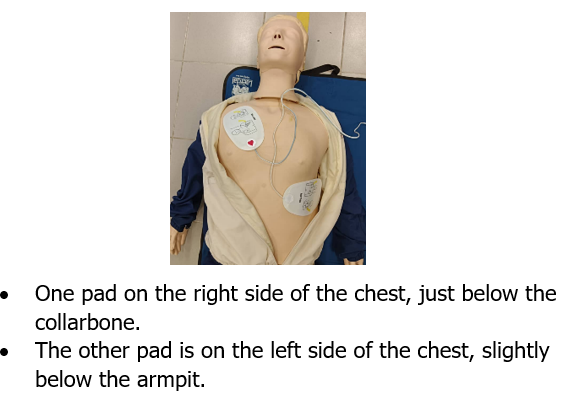
- Right chest (upper right side): Place one pad just below the collarbone, to the right of the breastbone.
- Left chest (lower left side): Place the other pad on the left side of the chest, a few inches below the armpit, along the ribcage.
b) For children under 8 years or <25 kg (use paediatrics pad if available)
- Use a paediatric pad if available. If not, may use the adult pad. Do not cut the adult pad smaller, as it may inhibit the effectiveness of the shock delivered.
- Paediatric pads: Located in a similar position to the adult pads.
- Adult pads: one on the chest (centre) and the other on the back (between shoulder blades).
6.3 Steps to Use an AED
a) Prepare the chest
- Make sure the chest is dry and free from body hair. This allows the pads to adhere properly and function effectively.
b) Power on the device
- Activate the AED and pay attention to the audio or visual instructions provided.
c) Attach the pads
- Refer to the diagrams or instructions provided on the AED. If the victim has a pacemaker, avoid placing the pad directly over it, as this can interfere with the device’s function and reduce the effectiveness of the shock. Attach the pad below the pacemaker.
d) Rhythm analysis
- Once the pads are secured, the AED will automatically analyse the heart rhythm.
e) Shock delivery (if indicated):
- Automatic AEDs charge and deliver the shock on their own after warning rescuers to stand clear.
- Semi-automatic AEDs require the user to press the designated shock button when instructed. (Take care not to mistake this for the power button during the emergency.)
- Warn those nearby that a shock will be administered and instruct them to avoid any contact with the victim.
f) Provide CPR and re-check
- After a shock or if no shock is advised, continue to perform CPR for about two minutes before the AED reassesses the rhythm. Always follow the device’s step-by-step directions.
g) Continue care
- Keep using the AED and performing CPR until trained emergency personnel arrive and take over.
Important reminder:
Do not touch the victim while delivering a shock.
Key Takeaways
- Do not use the AED in standing water or on a wet chest, as moisture can reduce effectiveness and pose safety risks.
- Make sure no one is in contact with the patient when the AED is analyzing or delivering a shock to avoid accidental injury.
- Remove clothing, wipe sweat, and remove medication patches or excessive chest hair to ensure good pad contact.
- Use the AED as soon as available and strictly follow its instructions, as it is designed to guide first aiders safely and effectively.