
Chapter 1: The Impact of Global Trade Wars on International Business
“The world economy is like a spider’s web; if one thread gets pulled, the ripples are felt across the globe.” – Anonymous
Global trade wars have become one of the defining issues of modern international business. These disputes between major economic powers, such as the ongoing U.S.-China trade war, have forced companies to adapt rapidly, rethink their strategies, and navigate an increasingly unpredictable global market. As tariffs rise, non-tariff barriers grow, and supply chains face disruption, businesses must find new ways to cope. This chapter explores the rise of global trade wars, their causes, and how they have reshaped international business operations.
The Rise of Global Trade Wars
Trade wars are not new in the history of international trade, but their scope and scale have evolved significantly in recent years. The U.S.-China trade war, which began in 2018 under President Donald Trump’s administration, is a perfect illustration of the dramatic rise in protectionism and its effects on global business. Trump’s “America First” policy was aimed at addressing trade imbalances, particularly with China, the world’s second-largest economy. As tariffs on billions of dollars’ worth of goods were imposed, retaliation followed in kind, creating an environment of increasing uncertainty.
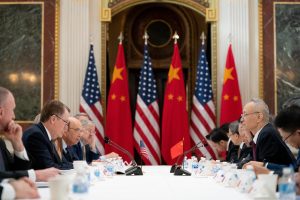 “US-China 7th discussion on trading issue” by Tia Dufour, White House is licensed under CC0.
The U.S.-China trade war, often viewed as a clash of two titans, is just one example of a broader, global trend toward protectionism. Nations like the U.K., Brazil, and even India have introduced trade restrictions in recent years, causing ripple effects in the global economy. Former U.S. President Ronald Reagan once said, “The best way to keep people poor is to isolate them from the rest of the world.” Yet, today’s political climate seems to suggest the opposite: isolation and protectionism are being embraced as solutions to address domestic economic woes.
This shift has been fuelled by multiple factors. First, the post-2008 financial crisis global recession left many nations struggling with stagnation and rising unemployment, particularly in manufacturing sectors. Protectionist policies were then adopted as a means to revive domestic industries. Further driving the rise of protectionism is the increasing perception of a “zero-sum game,” where one nation’s gain is perceived as another’s loss. This has resulted in heightened nationalism and a preference for “America First” or “Brexit-style” isolationism.
The Impact on Global Supply Chains
The most immediate impact of global trade wars is felt in the disruption of supply chains. A multinational corporation like Apple, which relies heavily on global supply chains, serves as a perfect example. The company’s manufacturing is split between China, India, and Vietnam, while its consumer market stretches across North America, Europe, and Asia. The imposition of tariffs on Chinese-made products has forced Apple, and countless other companies, to reconfigure their supply chain strategies. The Wall Street Journal reported that Apple was forced to consider moving a significant portion of its production out of China to avoid tariffs that could disrupt its profitability (Chiu, 2019). Such moves come with considerable costs – not just financial but also operational, as businesses have to manage new supply chain partners, logistics, and regulatory hurdles in unfamiliar territories.
Trade wars like the U.S.-China dispute also introduce increased unpredictability into the global trade system. Businesses can no longer rely on the predictable and stable supply chains that have been the foundation of the post-World War II global economy. Disruptions to international trade routes, such as the temporary closure of ports or customs delays, become commonplace. As the Harvard Business Review puts it, “In today’s world, no business is isolated from the ripple effects of global trade wars. The shockwaves are felt across industries, markets, and borders” (Porter & Kramer, 2020).
Strategic Responses to Trade Wars
Faced with these disruptions, businesses have no choice but to adapt. One of the most common strategic responses is market diversification. For example, U.S. manufacturers, long dependent on Chinese imports, have begun shifting their production lines to other countries, such as Mexico and Vietnam. According to The Economist (2020), companies like Nike and Samsung have already restructured their operations to include new supply chain hubs in Southeast Asia, which offer lower costs and less exposure to the U.S.-China tariff war.
Reshoring, or bringing manufacturing back home, has also been touted as a solution. In 2017, Apple announced that it would manufacture some of its Mac computers in the United States for the first time in decades, a move that reflected the changing political climate and the company’s desire to reduce reliance on China. While reshoring may reduce exposure to global trade wars, it is not a panacea. High domestic production costs and a shortage of skilled labour in many developed economies mean reshoring may only be feasible for certain industries.
The introduction of new technology also plays a pivotal role in business strategy during trade wars. Companies are increasingly turning to digital solutions to streamline operations, automate processes, and manage supply chains more effectively. AI-powered logistics systems, data analytics, and blockchain technology are all part of the modern toolbox businesses use to navigate trade-related challenges.
The Future of Global Trade Wars
Looking ahead, the future of trade wars is uncertain. The Biden administration, which inherited the U.S.-China trade conflict, has made some attempts at de-escalation but has largely maintained many of the previous tariffs. On the other hand, China has taken steps to diversify its own economic partnerships through its Belt and Road Initiative (BRI), which aims to deepen trade relations with Africa, Asia, and Europe. The result is an increasingly complex web of alliances, trade deals, and disputes that will continue to evolve over the coming years.
For businesses, the key to surviving in this volatile environment will be flexibility. As Tim Cook, CEO of Apple, once said, “You’ve got to be willing to change direction when the winds of change blow.” This adaptability, combined with market diversification and technological innovation, will be essential for companies looking to thrive in the unpredictable landscape of global trade wars.
In conclusion, global trade wars are forcing businesses to rethink their strategies. The days of relying on stable, cost-efficient global supply chains are over. Instead, businesses must be prepared to navigate an increasingly protectionist world by diversifying markets, reshoring production, and leveraging new technologies. The future of international trade, while uncertain, will require companies to remain agile and adaptable in the face of ever-changing political and economic pressures.
This video presents the announcement by the Prime Minister of Canada, Justin Trudeau in response to U.S. tariffs on Canada.
“Announcement in response to U.S. tariffs on Canada” by Justin Trudeau – Prime Minister of Canada in YouTube is licensed under CC BY 3.0.
References:
- Chiu, A. (2019). “How the Trade War is Affecting Apple.” The Wall Street Journal. Retrieved from https://www.wsj.com
- Porter, M. E., & Kramer, M. R. (2020). Creating Shared Value: A New Approach to Business and Society. Harvard Business Review Press.
- The Economist. (2020). “The Trade War’s Lasting Impact on Global Business.” The Economist. Retrieved from https://www.economist.com
- Irwin, D. A. (2017). Clashing over Commerce: A History of US Trade Policy. University of Chicago Press.
- Baldwin, R. (2020). The Great Convergence: Information Technology and the New Globalisation. Harvard University Press.